

Well Balanced Diet
- Vol.03
Diet Q&A - Vol.02
Drink yourself healthy - Vol.01
Eat yourself healthy

Diet Q & A
QUESTION

- Why do people gain weight?
- There aren't any problems accompanying weight gain.
- Do some people gain weight easily, while others don't seem to gain weight?
- If I was overweight as a child, does that make it more difficult for me to lose weight as an adult?
- All of my family is overweight, so no matter what diet we choose we won't lose weight.
- I'm the same height and weight as my friend, but our body types are different. Can I change my body type?
- Can you give me some tips on how to make my diet a success?
- If there are two people of the same weight, why can one look thin while the other looks overweight?
- What can I do to decrease my body fat?
- What does "burning body fat" mean?
- I'm confused by the different ways of calculating my ideal body weight.
- What is "ideal body weight"?
- Can I increase my basal metabolism?
- How do I measure my body fat?
- Is it true that if I rebound from a diet a number of times, I gain weight easier than before?
- What are important points to remember during my everyday life when I am dieting?
- What is the yo-yo phenomenon?
- Is it true that it is more difficult to lose weight as I reach 40 and over?
- What kind of illness is osteoporosis?
- How much should I reduce my body fat?
- I always gain 1-2kgs before my period, why is this?
- What is "hidden obesity"?
- What is the "Body Fat Percentage"?
- Do bodyweight and body fat percentage decrease in the same ways?
- I have heard of apple-type obesity and pear-type obesity, what do these terms mean?
- What is an ideal diet?
- What does it mean to be the type of person that "gains weight easily" or "doesn't gain weight easily"?

The basic principal of losing weight is to consume less energy than you expend. "Consumed energy" is the amount of energy you put into your body through eating. "Expended energy" is the amount of energy that your body uses to maintain your body, for example by keeping your heart beating, and moving around in daily activities. Naturally then, anyone can become thin if they consume less energy than they expend.
Some time ago, it was often said that the required daily calorie intake for Japanese adult men was 2500 kilocalories and 2000 kilocalories for women. However, today the required daily calorie intake is said to be 2100 kilocalories for men, and 1800 kilocalories for women.
Although the "required calorie intake" numbers are 2000 kilocalories or 1800 kilocalories, actual nutritional requirements differ depending on age, height, and sex. Even in the same age group, there are both large and small people. There are also differences in the intensity of people's daily activities due to differing types of work. Obviously, the energy requirements of people that do physical labour-oriented work is different to that of people who do office work. There are many types of people, for example people who work in offices, people who work out of the office, people who don't use their bodies at all for work, sports athletes, and people who work on building sites. However, it can be said that people living in cities generally have lower lifestyle intensity than those living out of cities.
It would be easy to think then that people of the same sex, same age, and approximately the same build with the same type of lifestyle intensity would require the same amount of nutrition every day, but this is not the case. This is because everyone's basal metabolism and absorption efficiency is different. Obesity is caused by the accumulation of one's past lifestyle. There are 10 points in reducing obesity. It could be said that obese people have probably lived their lives until now in complete opposite of these 10 points.
So, in order to reduce obesity, let's look at the causes of obesity and the type of "lifestyle" that can reduce or prevent obesity.
[10 Points for Reducing Obesity]
- Eat a good breakfast and lunch, and light evening meal.
- Remember to chew your food slowly and well.
- Aim to eat a more varied diet rather than more quantity.
- Always remember to eat in moderation.
- Get used to lightly seasoned flavours that are good for your body.
- Try to resist snacking and alcohol as much as possible.
- Keep a regular lifestyle and maintain your lifestyle rhythm.
- Weigh yourself every day.
- Don't let stress build-up.
- Take moderate exercise every day.


Oh really? Sometimes overweight people say this. However, it is said that obesity is the cause of 10,000 illnesses. Illnesses that include diabetes, high blood pressure, infertility, gallstones, gout, cardiac disease, and many others. The possibility of contracting one of these illnesses increases greatly with obesity. Obesity causes a great burden on your body's internal organs, which causes various adult diseases. If you are overweight yet still don't have any problems, now is a golden opportunity to start dieting.
Statistically speaking, when comparing obese people with people at their optimum weight, it is said obese people are
5 times more likely to become diabetic
2.5 times more likely to suffer from gout
3 times more likely to suffer from gallstones or infertility
Twice as likely to suffer from cardiac disease
2.5 times more likely to suffer from high blood pressure
1.5 times more likely to suffer from joint failure
Additionally, women are more likely to suffer from endometrial cancer, ovarian cancer, or breast cancer, and men are more likely to suffer from a combination of virulent diseases such as large intestine and prostate cancer.
Yes, they do. It can be said that people whose parents were overweight, or who were overweight in childhood, have a physical tendency that gains weight more easily. When compared to people that don't gain weight easily, those that do gain weight easily gain weight from overeating just a little.
Also, if a person's basal metabolism falls unusually, they will gain weight more easily. This happens if you were to continue eating low calorie meals for a long time.
However, this type of person can increase their basal metabolism and making it more difficult to gain weight through exercise etc.

Once the number of fat cells in the body increases, they almost never decrease again. In particular, the number of a person's fat cells increasing more than what is required during adolescence is a major cause of obesity. If you have children, make sure they do not overeat during this period of their lives.
There are two types of obesity that differ depending on the quantity and size of the fat cells. In the first type, "increased formation obesity", many sufferers were overweight since childhood, whereas in the second type in which the fat cells are large, "tumescent obesity", many sufferers become overweight when middle-aged. As the number of fat cells does not decrease but the size of the fat cells change, it can be said that those who gain weight when middle-aged can lose weight easier than those who were overweight since childhood.
It is often said that most men visualize their own faces in their father's or relative's bodies to try and predict whether or not they will become bald in the future. As long as we continue to be born from a mother and father, we can never escape from heredity. If we sometimes meet people that say, "I gain weight no matter what I do", we also meet people that say, "I never gain weight no matter what I eat". But is obesity really down to heredity? It does seem that obesity is linked in some way to family lines.
Some interesting data on heredity and obesity reveals that,
1. If both parents are obese …… 70% of children are obese
2. If one parent is obese …… 40% of children are obese
3. If both parents are not obese …… 10% of children are obese
Also, we can see different facts from other types of data. Such data shows that when one parent is overweight, the probability of the children also being obese is lower when the overweight parent is the father than when it is the mother. Mothers have a far more overwhelming effect on a child's lifestyle than a father does. In other words, if the mother makes oversized or unhealthy meals, overeats, or does not take regular exercise, the children naturally assume the same lifestyle, and their probability of becoming obese increases. Therefore, this means "obesity comes from the family kitchen".
What we can be sure of though, is that obesity is caused by a combination of heredity and environmental factors.
But instead of saying "my parents were overweight so there is nothing I can do about it", a better attitude would be to say, "heredity counts for 30%, environment counts for 70%".
There are 2 possible reasons for differences in body type. The first is differences in build. The impression we get of a people changes dramatically by looking at the face and width of shoulders. The second is the ratio of muscles and fat, and where they are arranged on our bodies. Often people that have a large amount of subcutaneous fat appear plump and chubby.
It is impossible to change your natural build, but you can reduce fat by undertaking exercise such as walking, and increase muscle through dumbbell exercises and other such exercise. However, be careful that you reduce your body fat to within the proper range, and not below that range.
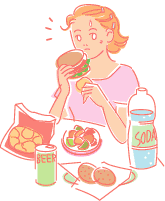
First of all, review your current lifestyle. "I started a diet but it didn't last." "It was too stressful." "I gained weight again as soon as I stopped." There are many people that talk about such experiences. The reason why many diets fail is because people do not consider why they are overweight in the first place, and that they start to lose weight without knowing properly how to lose weight. In order to diet successfully, you must first make a full record of one day of your life. It is essential to look over your own lifestyle, to find the areas which have trouble lurking, and to patiently correct each of the problem areas one at a time.
The success or failure of a diet is measured by whether you can keep your new lower bodyweight. Reducing your weight slowly in as natural way as possible is the best way to reduce the influence of rebounding. This is the secret to dieting success.
The first step towards successful dieting is to record all of your eating habits, bodyweight, and lifestyle. Because one of the main reasons of gaining weight is lifestyle, it is effective to record details about your lifestyle so you can make improvements. Obesity is the accumulation of many daily activities. These must be corrected one at a time. There are no short cuts in dieting.
The other reason for differing body types is the ratio of muscle and fat, and differences in the areas of the body where fat accumulates. It can be said that people who look plump probably have thicker layers of subcutaneous fat, yet those who are the same height, weight, and sex but look thinner are more muscular and have thinner layers of subcutaneous fat.
It is impossible to change your build. However, by playing sports or other physical activities you can gradually weaken body fat, and by increasing your muscle mass, you will look thinner and feel livelier even if your bodyweight doesn't change.
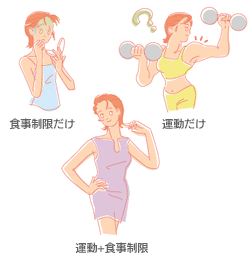
To reduce body fat, it is important to control both nutrition and exercise. You cannot successfully diet by controlling only one of them. When considering your meals, it is of course important to be careful of calories. However, there are many people that are under the misunderstanding that fat does not accumulate unless you eat it. Even with sugar, if the amount of energy taken in is not entirely used up, the remaining energy accumulates in the body as fat. Remember this when preparing your meals.
When considering exercise, fat begins to be burned effectively about 20 minutes after starting exercise. Walking at a quick pace, fast enough to make your breathing rate increase is recommended over other exercises such as jogging. Walk for 30 minutes-1 hour, 1-2 times per week. Walking is a simple exercise that can be done by anyone. Of course, other exercises such as aerobics and aero-bikes are also OK. Also, if you are currently under any kind of medical treatment, always consult with your physician before starting any program of exercise.
Burning fat means to make the energy required for muscles to move from body fat. When we do exercise, our muscles move. And fat creates the energy that our muscles use to move.
If you are obese, it means that your body has a lot of energy stored up as fat, but does not have a great deal of muscle that uses the energy. Therefore, you can do aerobic exercise such as walking so that your body takes in oxygen to burn body fat, and also combine that with exercises to build muscle.
Out of the various ways for calculating body weight, we recommend using the BMI calculation method to find your ideal body weight. The formula is 22 × height (m) × height (m).
However, the body fat percentage is the best way to find out whether you are overweight. The method of using the BMI to calculate your ideal body weight has excellent correlation to the body fat ratio, which is why we mentioned it here.
Before starting to reduce your bodyweight, lets first check to make sure that you are in fact overweight. The standard guide for this is the ideal body weight. We can also presume to call this your optimal weight. So, lets calculate your BMI. Insert your own height and weight into the formula below, and then calculate the results.
[BMI Formula]
BMI= Weight (kg) ÷ Height (m) ÷ Height (m)
[Judging whether you are overweight from your BMI]
| BMI Value | Below 18.5 | 18.5-25 | 25-30 | Above 30 |
|---|---|---|---|---|
| Judgment | Underfat | Healthy | Obese level 1 | Obese level 2 and over |
*[Obesity Research] table of results published in April 2000 issue of Japan Society for the Study of Obesity (JASSO) magazine.
BMI (Body Mass Index) is used by a wide range of doctors who are researching obesity to calculate the ideal body weight from a person's height.
If the value calculated using the BMI method falls within the normal range of values, statistically that person should be healthy. Whereas if the calculated value is higher or lower than the normal range, that person is statistically more vulnerable to illness. When plotted on a graph, this line looks similar to a capital J, so it is therefore called the J curve. It is clear from a wide range of data that people who force themselves to lose weight even though they don't need to lose weight can damage their health.
The basal metabolism value drops due to a poor diet or lack of exercise, but conversely rises if light exercise is continued.
We also know that reducing meals excessively can cause the basal metabolism to drop greatly. This is because your body has a self-defence mechanism that operates when you move your body with only a small amount of energy.
In this case, you will gain weight even if you don't eat a great deal.
One further point. Your basal metabolism peaks at your mid 20s, and slowly begins to reduce as you get older.
Continuing to eat as you did when you were younger without doing any exercise can cause obesity or "middle-age spread" during your middle years. As long as you continue to lead a regular lifestyle, eat properly, and take regular exercise, your basal metabolism should not fall below the average for your age.
You need to measure your body fat amount to know whether or not you are obese. Obesity is when the percentage of body fat has increased to a high proportion. So, how do you measure the amount of body fat? Until recently, [body-fat callipers] or [water scales] were used to measure body fat. Because body-fat callipers involve pinching an area of subcutaneous fat to take a measurement, there are often differences in measurement values between measurers. On the other hand, water scales are an accurate way of measuring body fat that are used in universities or research facilities, but they were devised for professional use and not for home use. Unfortunately, you cannot use either the calliper method or water scale method to easily measure your own body fat.
This is why Tanita have developed and released the "all-in-one scale and body fat meter" to enable the "dream measurement" of body fat to be measured easily.
The Tanita "All-in-one scale and body fat meter" uses an impedance measurement method (BIA method) to send a low, safe electrical signal through the body, which it then uses to measure the amount of body fat from the living tissue impedance. This means you can measure your body fat ratio easily just by stepping on the meter.
We strongly recommend that you at least once try one of our all-in-one scale and body fat meters to measure your own body fat ratio.
Lets imagine you eat only one item of food to diet quickly and reduce your calorie intake. In this case, your body would think that it was being starved due to the unavailability of food, and a number of body functions would start to protect your body. Firstly, an enzyme that works to turn neutral fat into fatty tissue becomes active, making it easier for your body to store fat. This is the cause of the so-called rebound effect. So even after making the big decision to diet and working hard to control your calorie intake, one week after finishing the diet your body returns to its old condition, and your weight may even increase above its old condition, causing an unhappy ending to the experience.
A more worrying result would be differing fluctuations in your weight and bodyweight. If your body fat is not reduced by the diet then other elements (such as muscle) are reduced, which means your actual body fat ratio increases. And when a rebound occurs, something rather frightening is happening inside your body. The exact amount of weight increase is entirely body fat, which means that your body fat ratio has increased.
There are a number of reports that conclude that for this reason, rebounding a number of times can cause a greater risk of adult diseases.

First of all, review your current lifestyle. "I started a diet but it didn't last." "It was too stressful." “I gained weight again as soon as I stopped." There are many people that talk about such experiences. The reason why many diets fail is because people do not consider why they are overweight in the first place, and that they start to lose weight without knowing properly how to lose weight. In order to diet successfully, you must first make a full record of one day of your life. It is essential to look over your own lifestyle, to find the areas which have trouble lurking, and to patiently correct each of the problem areas one at a time.
The success or failure of a diet is measured by whether you can keep your new lower bodyweight. Reducing your weight slowly in as natural way as possible is the best way to reduce the influence of rebounding. This is the secret to dieting success.
The first step towards successful dieting is to record all of your eating habits, bodyweight, and lifestyle. Because one of the main reasons of gaining weight is lifestyle, it is effective to record details about your lifestyle so you can make improvements. Obesity is the accumulation of many daily activities. These must be corrected one at a time. There are no short cuts in dieting.
This refers to repeated changes in weight such as rebounding or weight cycling. Recently, these terms are being heard more frequently. So, why would a person's weight change repeatedly? This is because a number of self-protective functions within the body are operating to keep the body weight at one specific level. Research into adult illnesses has shown that the more a person loses and then gains weight (weight cycling), the more difficult it becomes to lose the weight.
This problem occurs at middle age because of lifestyle problems. When entering middle age, people's basal metabolism decreases, yet they continue to eat as they did when they were younger, and opportunities to exercise decrease. This creates a set of conditions that makes it difficult to lose weight. However, as most cases of "middle-aged spread" are caused by tumescent obesity in which the fat cells are large, it is the easier type of weight to lose. Therefore, weight can be lost by completely reviewing your lifestyle.
Although it used to be called the mark of long life, typical sufferers of osteoporosis have severe bending of the back in the shape of a shrimp. Osteoporosis is a disease in which the bones become extremely thin, and bone density decreases. The overwhelming percentage of sufferers is women, with a 2:8 ratio of men to women suffering from the disease. Furthermore, the bone density reduces with age. However, recently osteoporosis has been found in women in their 20s.
Osteoporosis can be caused by simple one-item diets that are dramatically deficient in calcium. In one study, it was found that in modern times, 10% of people could suffer from a broken bone at any time.
To improve osteoporosis, sufferers need to intake calcium and vitamin D, be exposed more to sunlight, and to exercise. By being careful of the balance between food and exercise, it is possible to prevent the reduction of bone density that occurs with age to a certain extent.
Osteoporosis used to be thought of as an elderly-person's illness. Now, however, osteoporosis can be seen in many young people too. To prevent this type of result, we recommend the correct balance between good nutrition and exercise.
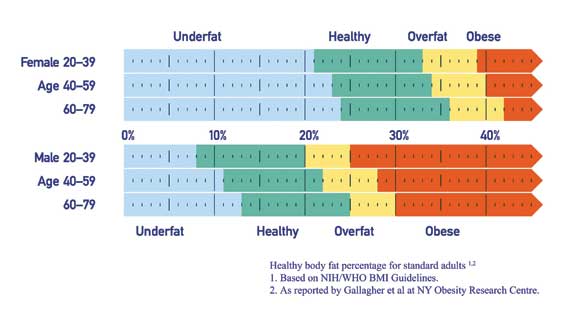
The ideal numerical range was calculated from statistical data of people at a certain body fat ratio that were less prone to illness. Therefore, if your value is greater than or less than that of a person in the ideal range, you are statistically more likely to become ill. When plotted on a graph, this line looks similar to a capital J, so it is therefore called the J curve.
[Judgment Table from Body Fat Ratio]
Progestational hormones concentrations increase before your period. These hormones cause water and salt to be stored in each cell, which causes your body to become slightly swollen, and delays the metabolism of fat making it easier for your body to store fat.
This is why it is normal for you to gain 1-2kg before your period. However, once your period is over, levels of this hormone are reduced, and your bodyweight returns to its previous level.
If over their ideal bodyweight, most people think "Oh no, I'm fat!". Using one of the methods to calculate ideal weight - Ideal weight =(height-100) × 0.9: (Broker-Katsura method) - we do not know whether we are overweight or not.
This is because we can only decide if people are -obese- by finding out the proportion of fat in the body. Just by looking at bodyweight alone, many people who would fall into the normal range for body fat yet exceed the bodyweight average.
This is the so-called "hidden obesity".
Even if 2 people's bodyweight is the same, it follows that their level of obesity would be completely different if one person trained their body in sports frequently, while the other rarely played sports. If the reason why a person's bodyweight increases is due to an increase in muscle or bone, that person is not judged as being obese.
Let's look at the judgment table of obesity from body fat ratio below.
[Judgment Table from Body Fat Ratio]
The body fat ratio represents the percentage of body fat inside your body. Until now, many people watch how heavy or light their body weight is to decide if they are overweight. However, whether or not you are obese is determined by the body fat percentage. So, why was obesity judged on ideal body weight etc? One reason is that body fat could not easily be measured. However, recently we have become able to easily measure body fat at home, which means that it is possible to judge obesity from the body fat ratio.
Let's look at the judgment table of obesity from body fat ratio below.
[Judgment Table from Body Fat Ratio]
To lose weight correctly, bodyweight should increase along with body fat. However using a poor method of weight loss-for example using a diet that consists of simple methods only to reduce weight - will not reduce body fat. In such cases as these, the body fat ratio actually increases as the bodyweight decreases.
If your body fat is not reduced by this type of diet then other elements (such as muscle) are reduced, which means your actual body fat percentage increases. And when a rebound occurs, something rather frightening is happening inside your body. The exact amount of weight increase is entirely body fat, which means that your body fat percentage has increased.
There are a number of reports that conclude that for this reason, rebounding a number of times can cause a greater risk of adult diseases.
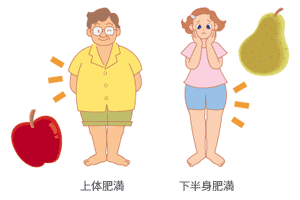
There are different ways that your body could gain weight. Upper body obesity is where the stomach region becomes paunchy, whereas lower body obesity is where the thigh and buttock areas become fatter. The upper body obesity type can also be called apple-type obesity, and the lower body obesity type can be called pear-type obesity.
The most worrying type of the two is apple-type obesity. It is often said that apple type obesity makes people more susceptible to adult illnesses such as diabetes and high blood pressure.
Then, how can we judge if a person is apple-type obese? This is done by comparing the size of the waist (size around the belly button) and hips (largest size around the hip area). If the waist/hip ratio is 1.0 or over for men, or 0.8 or over for women, that person is apple-type obese. Recently, it has been suggested that apple-type obesity be further divided into new categories of "subcutaneous fat type obesity" and "viscera adipose obesity". This is because the latter type of obesity has been found to have more connections with adult diseases.
At this point there is an important message to young women. The body fat mainly stored as pear-type fat plays an important role as a source of energy during pregnancy and childbirth. Therefore, we recommend that you don't go through any drastic diets to remove body fat from the lower half of your body.
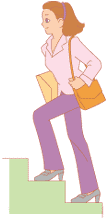
A body that gains weight easily is created from poor nutrition and lifestyle over a long period of time.
When you eat a meal, are you sure you aren't eating too quickly? By eating quickly, you already overeat before your brain registers that you are full. By eating over a 20-30 minute period, you can prevent overeating by giving your brain time to register you are full. Also, our body temperature increases slightly after eating. Heat is emitted to allow your metabolism to increase and process the nutrients that you have taken into your body through eating, and this energy is used and lost in simply raising your body temperature. This is called a [Specific Dynamic Action], which operates to a large extent after breakfast, and to a lesser extent after dinner. This action is the reason why midnight snacking or eating before sleeping cause obesity. Furthermore, in our stress-filled modern society, many people eat to compensate for this psychological stress, but this type of eating also causes obesity. So how is your daily lifestyle? The increasing convenience in our lifestyles coupled with mechanization and streamlining of work is causing a lack of exercise and a reduction in the amount of activity every day. For these reasons, our basal metabolism decreases making it easier for us to gain weight. You can make a body that does not gain weight easily by exercising on a regular basis and living an active life.
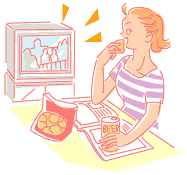
A body that gains weight easily is created from poor nutrition and lifestyle over a long period of time.
When you eat a meal, are you sure you aren't eating too quickly? By eating quickly, you already overeat before your brain registers that you are full. By eating over a 20-30 minute period, you can prevent overeating by giving your brain time to register you are full. Also, our body temperature increases slightly after eating. Heat is emitted to allow your metabolism to increase and process the nutrients that you have taken into your body through eating, and this energy is used and lost in simply raising your body temperature. This is called a "Specific Dynamic Action", which operates to a large extent after breakfast and to a lesser extent after dinner. This action is the reason why midnight snacking or eating before sleeping cause obesity. Furthermore, in our stress-filled modern society, many people eat to compensate for this psychological stress, but this type of eating also causes obesity. So how is your daily lifestyle? The increasing convenience in our lifestyles coupled with mechanization and streamlining of work is causing a lack of exercise and a reduction in the amount of activity every day. For these reasons, our basal metabolism decreases making it easier for us to gain weight. You can make a body that does not gain weight easily by exercising on a regular basis and living an active life.